
Anthropic เปิดตัว Claude Haiku 5.5 โมเดล AI จิ๋วแต่แจ๋ว

Anthropic เปิดตัว Claude Haiku 5.5 เมื่อวันที่ 7 ตุลาคม 2026 โดยชูจุดเด่นเป็นโมเดลขนาดเล็กที่คุ้มค่าและรวดเร็วที่สุดในตระกูล มาพร้อม Model ID claude-haiku-5-5 สำหรับการใช้งานผ่าน API
ราคาเริ่มต้นเพียง $0.10 ต่อหนึ่งล้าน input tokens และ $0.50 ต่อหนึ่งล้าน output tokens สำหรับ Prompt ที่ไม่เกิน 100,000 tokens บทความนี้จะเจาะลึกความเปลี่ยนแปลงจาก Haiku 4.5 พร้อมวิธีสร้างเวิร์กโฟลว์ด้วย Python ทั้งการจำแนกประเภท การสกัดข้อมูล และระบบ Sub-agents
Haiku 5.5
Anthropic วางตำแหน่ง Haiku 5.5 ให้เหมาะกับงานที่มีปริมาณมากและต้องการประหยัดต้นทุน เช่น การสรุปความ การสกัดข้อมูล และการจำแนกประเภท รวมถึงการทำหน้าที่เป็น Sub-agent ทำงานร่วมกับรุ่นพี่อย่าง Opus 5.5 และ Sonnet 5.5
ปัจจุบันพร้อมใช้งานแล้วบน Claude Platform, Amazon Web Services, Google Cloud และ Microsoft Azure โดยสามารถตรวจสอบผลการประเมินความปลอดภัยได้ใน system card ซึ่ง Anthropic ระบุว่าโมเดลนี้จะมีอายุการใช้งานอย่างน้อยถึงวันที่ 7 ตุลาคม 2027 ตามข้อมูลในหน้าการยกเลิกใช้งาน
มีอะไรใหม่เมื่อเทียบกับ Haiku 4.5?
| คุณสมบัติ | Haiku 4.5 | Haiku 5.5 |
|---|---|---|
| Context window | 200K tokens | 1M tokens |
| Max output | 64K tokens | 128K tokens |
| Thinking control | กำหนดงบการคิดด้วยตนเอง | Adaptive thinking พร้อมการตั้งค่าระดับความพยายาม |
| ราคาต่อล้าน tokens (Prompt ≤ 100K) | $1.00 / $5.00 | $0.10 / $0.50 |
| ราคาสำหรับส่วนที่เกิน 100K | $1.00 / $5.00 | $0.50 / $2.50 |
| Prompt ขั้นต่ำที่ทำ cache ได้ | 4,096 tokens | 512 tokens |
| ผลทดสอบความรู้ (GDPval-AA) | 735 | 1620 |
| การใช้งานคอมพิวเตอร์ (OSWorld 2.1) | 15.7% | 72.4% |
แม้ราคาที่ประกาศจะลดลงถึง 90% แต่ในทางปฏิบัติอาจต่างกันเล็กน้อยเนื่องจาก Haiku 5.5 ใช้ Tokenizer รุ่นใหม่ที่นับจำนวน tokens มากขึ้นราว 30% อย่างไรก็ตาม Anthropic ประเมินว่าโดยรวมแล้วจะช่วยประหยัดต้นทุนเฉลี่ยได้ประมาณ 75%
สิ่งที่นักพัฒนาต้องระวังคือการเปลี่ยนแปลงใน API ที่อาจทำให้โค้ดเดิมใช้งานไม่ได้ เช่น การส่งค่า temperature, top_p หรือ top_k จะส่งคืนข้อผิดพลาดทันที รวมถึงการเปิดใช้งาน Adaptive thinking เป็นค่าเริ่มต้น ซึ่งจะทำให้การตอบกลับเริ่มด้วย Thinking block และนับรวมใน max_tokens ด้วย นอกจากนี้โมเดลยังมีมาตรการป้องกันความปลอดภัยทางไซเบอร์ที่เข้มงวดขึ้น ซึ่งอาจบล็อกการทำ Penetration testing
การใช้ Haiku 5.5 สำหรับเวิร์กโฟลว์ที่รวดเร็วและราคาถูก
การใช้งานจำเป็นต้องมี Python 3.10 ขึ้นไป พร้อมติดตั้ง Anthropic SDK รุ่นล่าสุดเพื่อรองรับพารามิเตอร์ output_config แบบใหม่
pip install -U anthropic
export ANTHROPIC_API_KEY="your-key-here"
ขั้นตอนที่ 1: การจำแนกประเภทและการสกัดข้อมูล
Haiku ถูกออกแบบมาเพื่อรองรับงาน Input สั้นๆ และต้องการผลลัพธ์ที่มีโครงสร้างแน่นอน (Structured Output) โดยโค้ดตัวอย่างด้านล่างแสดงการใช้ JSON Schema เพื่อบังคับรูปแบบคำตอบให้ถูกต้องแม่นยำ
# haiku_tasks.py
"""Fast, cheap Claude Haiku 5.5 calls: classification and extraction with JSON outputs."""
import json

import anthropic

MODEL = "claude-haiku-5-5"
client = anthropic.Anthropic()    # reads ANTHROPIC_API_KEY from the environment

# USD per million tokens (input, output) for prompts up to 100K tokens.
PRICES = {
    "claude-haiku-5-5": (0.10, 0.50),
    "claude-sonnet-5-5": (2.00, 10.00),
    "claude-opus-5-5": (4.00, 20.00),
}

CATEGORY_SCHEMA = {
    "type": "object",
    "properties": {"category": {"type": "string", "enum": ["billing", "shipping", "technical", "other"]}},
    "required": ["category"],
    "additionalProperties": False,
}

INVOICE_SCHEMA = {
    "type": "object",
    "properties": {
        "vendor": {"type": "string"},
        "invoice_number": {"type": "string"},
        "total": {"type": "number"},
        "currency": {"type": "string"},
        "due_date": {"type": "string", "description": "ISO date, YYYY-MM-DD"},
    },
    "required": ["vendor", "invoice_number", "total", "currency", "due_date"],
    "additionalProperties": False,
}

def cost_usd(model, usage):
    price_in, price_out = PRICES[model]
    return (usage.input_tokens * price_in + usage.output_tokens * price_out) / 1_000_000

def ask_json(schema, instruction, text, model=MODEL, effort="low"):
    """One request whose reply must be JSON matching `schema`. Returns (data, usage)."""
    reply = client.messages.create(
        model=model,
        max_tokens=1000,    # thinking tokens count toward this limit, so leave headroom
        system=instruction,
        messages=[{"role": "user", "content": text}],
        output_config={"effort": effort, "format": {"type": "json_schema", "schema": schema}},
    )
    if reply.stop_reason in ("refusal", "max_tokens"):
        raise RuntimeError(f"No usable answer, stop reason: {reply.stop_reason}")
    # A reply can start with a thinking block, so pick the text block by type.
    answer = "".join(block.text for block in reply.content if block.type == "text")
    return json.loads(answer), reply.usage

def classify(text, model=MODEL):
    data, usage = ask_json(CATEGORY_SCHEMA, "Classify the customer message.", text, model)
    return data["category"], usage

def extract_invoice(text, model=MODEL):
    data, usage = ask_json(INVOICE_SCHEMA, "Extract the invoice fields from the text.", text, model)
    return data, usage

if __name__ == "__main__":
    for message in ["I was charged twice this month.", "My parcel never arrived.", "The app crashes on login."]:
        category, usage = classify(message)
        print(f"{category:<10} {usage.input_tokens} in / {usage.output_tokens} out  <- {message}")

invoice = "Acme Cloud Ltd, invoice AC-2291. Total due: 1,240.50 USD by 15 November 2026."
    fields, usage = extract_invoice(invoice)
    print(fields, f"(${cost_usd(MODEL, usage):.6f})")
ในฟังก์ชัน ask_json มีการตั้งค่า effort เป็น low เพื่อลดเวลาที่โมเดลใช้คิดกับงานง่ายๆ และมีการตรวจสอบ stop_reason เพื่อป้องกันข้อผิดพลาดกรณีคำตอบไม่สมบูรณ์ ทั้งนี้ควรระวังว่าฟีเจอร์ JSON Outputs ยังไม่มีให้บริการบน Amazon Bedrock ในขณะนี้
ขั้นตอนที่ 2: Sub-Agents
แนวทาง Sub-agent คือการใช้โมเดลขนาดใหญ่เป็นผู้ควบคุม (Lead) และใช้ Haiku หลายตัวทำงานเฉพาะทางขนานกันไป ดังที่ Cognition ใช้ Haiku 5.5 เป็นคู่หูใน Devin Fusion ร่วมกับ Opus 5.5
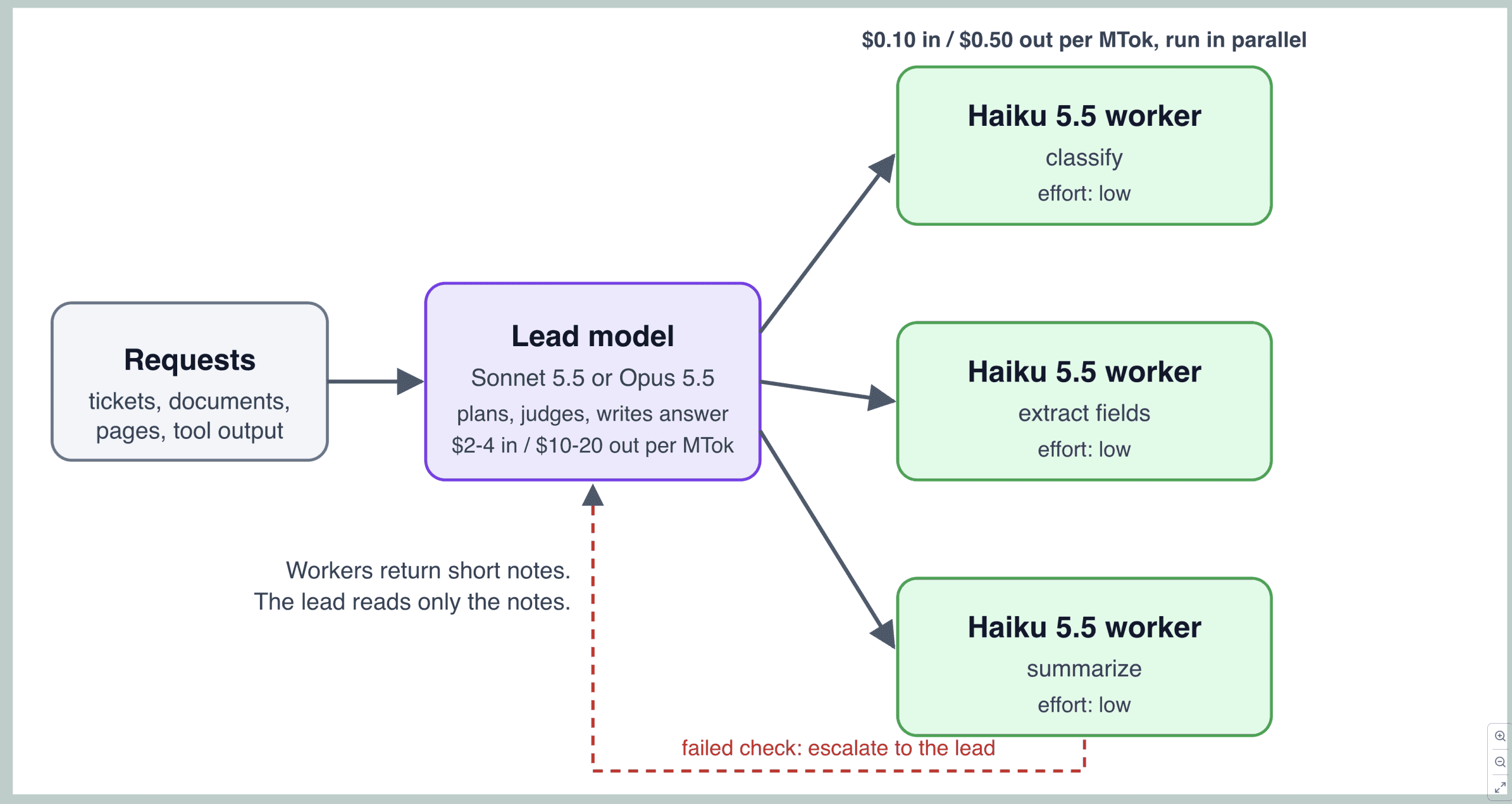
# subagents.py
"""A lead model delegates narrow jobs to parallel Haiku 5.5 workers, then writes the answer."""
import asyncio

import anthropic

from haiku_tasks import MODEL as WORKER, cost_usd

LEAD = "claude-sonnet-5-5"
client = anthropic.AsyncAnthropic()

def text_of(reply):
    return "".join(block.text for block in reply.content if block.type == "text")

async def summarize(name, document, limit):
    async with limit:    # cap how many workers run at once
        reply = await client.messages.create(
            model=WORKER,
            max_tokens=1500,
            system="Summarize the document in two sentences. Keep names, dates and amounts exact.",
            messages=[{"role": "user", "content": document}],
            output_config={"effort": "low"},
        )
    return name, text_of(reply), cost_usd(WORKER, reply.usage)

async def answer(documents, question):
    limit = asyncio.Semaphore(8)
    notes = await asyncio.gather(*(summarize(n, d, limit) for n, d in documents.items()))
    worker_cost = sum(cost for _, _, cost in notes)

brief = "\n".join(f"[{name}] {summary}" for name, summary, _ in notes)
    reply = await client.messages.create(
        model=LEAD,
        max_tokens=2000,
        system="You are the lead analyst. Answer using only the worker notes.",
        messages=[{"role": "user", "content": f"Question: {question}\n\nWorker notes:\n{brief}"}],
        output_config={"effort": "medium"},
    )
    return text_of(reply), worker_cost, cost_usd(LEAD, reply.usage)

if __name__ == "__main__":
    documents = {
        "contract-a": "Northwind renewed its support contract on 3 March 2026 for 48,000 USD per year.",
        "contract-b": "Contoso signed a 12-month license on 9 May 2026. The fee is 15,500 USD, billed quarterly.",
        "contract-c": "Fabrikam's agreement ends on 30 June 2026 and renews only if either party gives notice.",
    }
    text, worker_cost, lead_cost = asyncio.run(answer(documents, "Which agreements need action before July 2026?"))
    print(text)
    print(f"workers: ${worker_cost:.6f}  lead: ${lead_cost:.6f}")
ขั้นตอนที่ 3: การเปรียบเทียบต้นทุนและความหน่วง (Latency)
จากราคาประกาศ การรันงานจำแนกประเภทที่มี 300 input tokens และ 30 output tokens จำนวน 1,000 ครั้ง จะมีต้นทุนเฉลี่ยเพียง $0.045 สำหรับ Haiku 5.5 เมื่อเทียบกับ Sonnet 5.5 ($0.90) และ Opus 5.5 ($1.80)
ในด้านความเร็ว Anthropic ระบุว่า Haiku 5.5 เป็นโมเดลที่เร็วที่สุดในความเร็วมาตรฐาน โดยลูกค้าอย่าง Asana พบว่าความหน่วงลดลงกว่า 30% และ Box รายงานว่าความหน่วงลดลงถึงครึ่งหนึ่งเมื่อเทียบกับรุ่นก่อน
เมื่อใดควรเลือกใช้ Haiku และเมื่อใดที่ไม่ควร
Haiku 5.5 เหมาะสำหรับงานที่เฉพาะเจาะจง มีปริมาณงานสูง หรือต้องการการตอบสนองที่รวดเร็ว เช่น การกำหนดเส้นทางคำขอ (Routing) หรือการตอบคำถามจากเอกสารจำนวนมาก แต่สำหรับงานที่ซับซ้อนอย่างการเขียนโค้ดแบบ Agentic รุ่นใหญ่อย่าง Sonnet หรือ Opus ยังคงให้ผลลัพธ์ที่ดีกว่า
บทสรุป
การอัปเกรดครั้งนี้ทำให้ Haiku 5.5 เป็นคู่แข่งที่น่ากลัวในตลาดโมเดลขนาดเล็ก ด้วยราคาที่ถูกลง ประสิทธิภาพที่สูงขึ้น และการรองรับฟีเจอร์ใหม่อย่าง Computer Use และ Browser Use (Beta) ซึ่งจะช่วยขับเคลื่อนการทำงานของ AI Agent ในอนาคตให้มีประสิทธิภาพและคุ้มค่ามากยิ่งขึ้น
ความคิดเห็น (0)
เข้าสู่ระบบเพื่อร่วมแสดงความเห็น
สมัครสมาชิกมาเป็นคนแรกที่แสดงความเห็นกันเลยโบร