
คู่มือเขียนโค้ด TypeSafe AI Jev: ตัดสินใจแม่นยำด้วยโมเดล System One
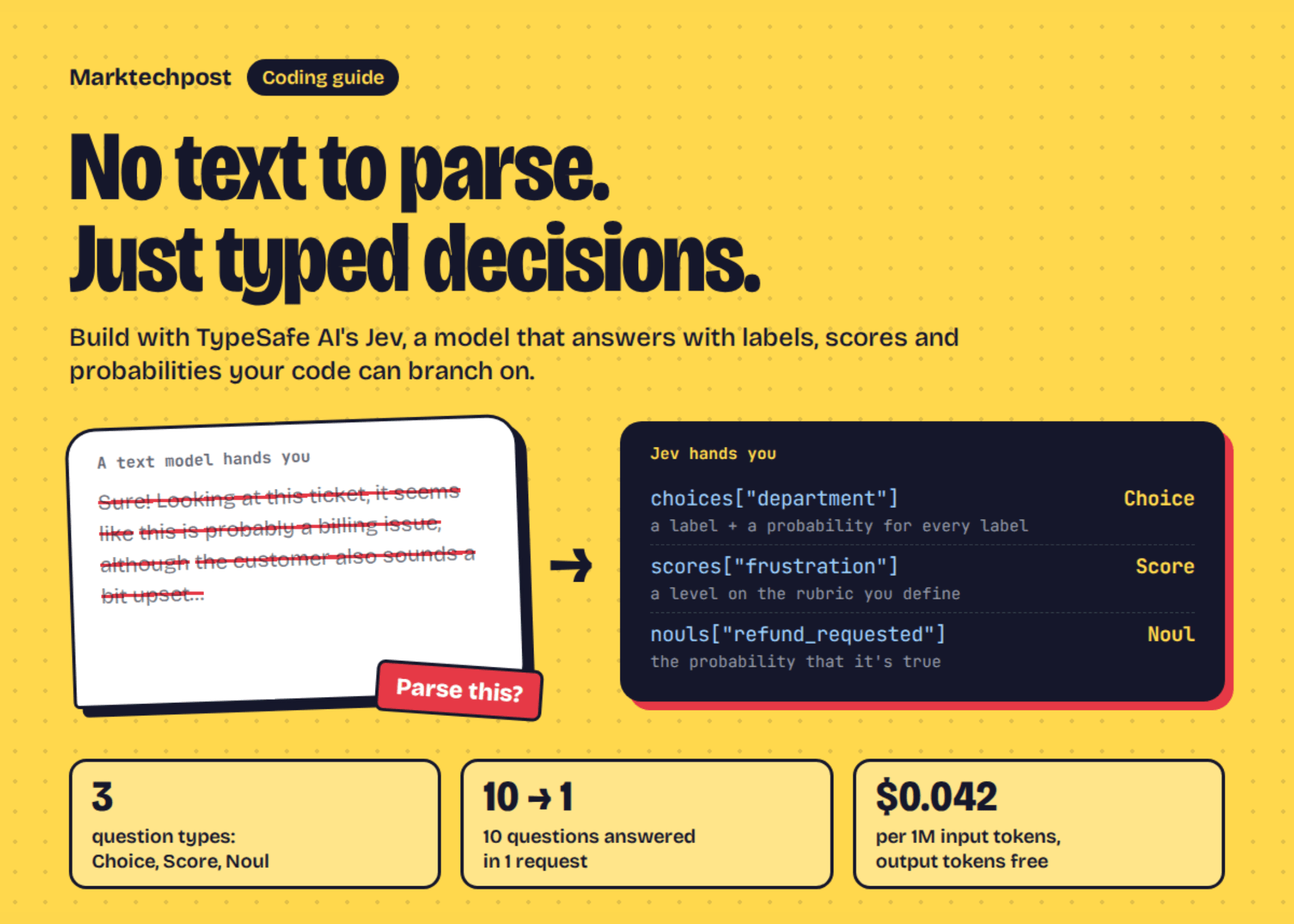
ใน บทช่วยสอน นี้ เราจะมาทำความรู้จักกับ
เราจะเริ่มจากการติดตั้ง Python SDK อย่างเป็นทางการ ทดลองเรียกใช้คำถามพื้นฐาน 3 รูปแบบพร้อมกัน และสังเกตว่าโครงสร้างของสถานะ (State) ส่งผลต่อการรับรู้ของโมเดลอย่างไร จากนั้นจะเข้าสู่การคำนวณสถิติความมั่นใจ การรวมคำถามเพื่อประหยัดต้นทุน และการสร้างเวิร์กโฟลว์ระดับมืออาชีพ เช่น การกำหนดเส้นทางตามระดับความมั่นใจ (Confidence-gated routing) และการให้คะแนนแบบผสม
0. เริ่มต้นติดตั้งและตั้งค่าระบบ
Jev
import os
import sys
import json
import time
import asyncio
import traceback
import subprocess
from getpass import getpass
RESULTS = {}
LEDGER = {"calls": 0, "input_tokens": 0, "output_tokens": 0}
USD_PER_MILLION_INPUT_TOKENS = 0.042 # Jev list price; output tokens are free
def banner(title):
print("\n" + "=" * 78)
print(title)
print("=" * 78)
def section(name):
def wrap(fn):
def run(*a, **kw):
banner(name)
try:
out = fn(*a, **kw)
RESULTS[name] = out if isinstance(out, str) else "ok"
return out
except Exception as e:
RESULTS[name] = f"SKIPPED / FAILED -> {type(e).__name__}: {e}"
print(f"\n[!] {name} did not complete: {type(e).__name__}: {e}")
traceback.print_exc(limit=3)
return None
return run
return wrap
banner("0. Install the SDK, load the API key, list the models")
subprocess.run([sys.executable, "-m", "pip", "install", "-q", "typesafe-sdk==0.7.0"], check=True)
import typesafe_sdk
from typesafe_sdk import Choice, Noul, Score, TypeSafeClient
def load_api_key():
key = os.environ.get("TYPESAFE_API_KEY", "").strip()
if not key:
try:
from google.colab import userdata # Colab: key stored under the Secrets tab
key = (userdata.get("TYPESAFE_API_KEY") or "").strip()
except Exception:
key = ""
return key or getpass("TypeSafe API key (console.typesafe.ai/keys): ").strip()
os.environ["TYPESAFE_API_KEY"] = load_api_key()
client = TypeSafeClient() # reads TYPESAFE_API_KEY, defaults to jev-latest
print(f" typesafe-sdk {typesafe_sdk.__version__} | Python {sys.version.split()[0]}")
print(" models available to this key:")
for m in client.models.list().models:
print(f" {m.name:<14s} released {m.release_date} {m.description}")
def ask(state, questions, **kw):
"""One System One call, timed, with its tokens added to the running ledger."""
t0 = time.perf_counter()
response = client.system_one(state, questions, **kw)
ms = (time.perf_counter() - t0) * 1e3
LEDGER["calls"] += 1
LEDGER["input_tokens"] += response.usage.input_tokens or 0
LEDGER["output_tokens"] += response.usage.output_tokens or 0
return response, ms
เราเริ่มต้นด้วยการติดตั้ง typesafe-sdk และโหลด API Key ผ่านช่องทางที่ปลอดภัย TypeSafeClient จะอ่านค่าคีย์โดยอัตโนมัติและใช้โมเดล jev-latest เป็นค่าเริ่มต้น นอกจากนี้เรายังสร้างฟังก์ชัน ask เพื่อช่วยบันทึกเวลาและจำนวน Token ที่ใช้ในการเรียกแต่ละครั้ง เพื่อนำมาสรุปยอดค่าใช้จ่ายในตอนท้าย
1. การใช้งานคำถามพื้นฐาน 3 รูปแบบ
TICKET = {
"ticket": {
"subject": "Duplicate charge",
"messages": [
{"from": "customer", "text": "I was charged twice for order A-104. This is the second time "
"this year. Please refund the duplicate today."},
{"from": "support", "text": "We are checking the charges."},
],
},
"order": {"id": "A-104", "charges": [{"amount_usd": 49, "status": "captured"},
{"amount_usd": 49, "status": "captured"}]},
"refund_policy": "Duplicate charges are eligible for a full refund within 30 days.",
}
@section("1. Three primitives, one call: Choice, Score, Noul")
def three_primitives():
response, ms = ask(TICKET, {
"department": Choice(
instructions="Which team should handle this ticket",
criteria={"billing": "Payment, refund or subscription issues",
"technical": "Bugs, outages or integration problems",
"sales": "Pricing, plans or account upgrades"},
),
"frustration": Score(
instructions="How frustrated the customer appears in `ticket.messages[0].text`",
criteria=["Calm, just stating facts", "Frustrated but civil", "Very angry, strong language"],
),
"refund_requested": Noul(instructions="The customer is explicitly asking for a refund"),
"policy_supports": Noul(instructions="The stated `refund_policy` covers this situation"),
})
dept = response.choices["department"]
print(f" department -> {dept.choice!r} confidence {dept.confidence:.3f}")
print(f" probabilities {({k: round(v, 3) for k, v in dept.probabilities.items()})}")
fr = response.scores["frustration"]
print(f" frustration -> score {fr.score:.3f} on 0..{len(fr.legend) - 1} confidence {fr.confidence:.3f}")
for level, text in fr.legend.items():
print(f" {level}: p={fr.probabilities[level]:.3f} {text}")
print(f" refund_requested -> noul {response.nouls['refund_requested'].noul:.3f}")
print(f" policy_supports -> noul {response.nouls['policy_supports'].noul:.3f}")
print(f"\n answered by {response.model} in {ms:.0f} ms "
f"input tokens {response.usage.input_tokens}, output tokens {response.usage.output_tokens}")
return f"{dept.choice}, frustration {fr.score:.2f}, refund {response.nouls['refund_requested'].noul:.2f}"
three_primitives()
คำขอของ System One ประกอบด้วย state (บริบท) และชุดคำถามที่ระบุประเภทไว้ Choice ใช้สำหรับเลือกหมวดหมู่, Score ใช้จัดลำดับความรุนแรงหรือคะแนนแบบถ่วงน้ำหนัก และ Noul ใช้หาความน่าจะเป็นแบบ ใช่/ไม่ใช่ คำถามทั้งหมดจะถูกประเมินพร้อมกันแบบขนานในหนึ่งคำขอ ช่วยให้การทำงานรวดเร็วและเป็นระบบ
2. ผลของโครงสร้างสถานะ (State Shapes)
@section("2. State is program state: the same question over a string and over named fields")
def state_shapes():
question = {"eligible": Noul(
instructions="The customer is eligible for a refund under the company's written policy",
criteria={"true": "A policy is present and it covers the customer's situation",
"false": "No policy is given, or the policy does not cover the situation"},
)}
bare = "I was charged twice for order A-104. Please refund the duplicate."
as_list = [m["text"] for m in TICKET["ticket"]["messages"]]
shapes = [("string: the message only", bare),
("array : the conversation", as_list),
("object: ticket + order + policy", TICKET)]
print(f" {'state shape':<34s} {'noul':>6s} input tokens ms")
seen = {}
for label, state in shapes:
response, ms = ask(state, question)
seen[label] = response.nouls["eligible"].noul
print(f" {label:<34s} {seen[label]:6.3f} {response.usage.input_tokens:12d} {ms:5.0f}")
print("\n Only the object carries the policy and the two captured charges; the question")
print(" is identical in all three calls, so any movement comes from the state.")
return "noul by state shape: " + ", ".join(f"{v:.2f}" for v in seen.values())
state_shapes()
โมเดลจะตัดสินใจได้ดีขึ้นเมื่อมีข้อมูลที่ครบถ้วน ในตัวอย่างนี้เราเปรียบเทียบการส่งคำถามเดิมผ่าน State 3 รูปแบบ คือ ข้อความเปล่า, อาเรย์ข้อความ และอ็อบเจกต์ JSON เต็มรูปแบบ จะเห็นว่าค่าความน่าจะเป็นเปลี่ยนไปตามความละเอียดของข้อมูลที่ได้รับ ซึ่งพิสูจน์ว่าโครงสร้างข้อมูลมีผลต่อการตัดสินใจของ AI
3. การคำนวณสถิติความมั่นใจ (Confidence Math)
def confidence_from(probabilities):
"""TypeSafe's published statistic: (count x peak - 1) / (count - 1)."""
p = list(probabilities.values())
return (len(p) * max(p) - 1) / (len(p) - 1)
@section("3. Confidence is a statistic of the distribution, and you can recompute it")
def confidence_math():
tone = Choice(instructions="What is the tone of the message",
criteria={"angry": "Upset or hostile", "calm": "Neutral or polite", "excited": "Enthusiastic or eager"})
urgency = Score(instructions="How soon this needs attention",
criteria=["Can wait", "Needs attention this week", "Needs attention today"])
messages = {
"clear ": "This is the third outage this week and nobody answers. Fix it NOW or I cancel today.",
"ambiguous": "Well. That was certainly an experience. Let me know when you get a chance.",
}
print(f" {'message':<10s} {'choice':<8s} {'API conf':>8s} {'recomputed':>11s} "
f"{'score':>6s} {'sum(level*p)':>13s} {'API conf':>9s}")
worst = 1.0
for label, text in messages.items():
response, _ = ask(text, {"tone": tone, "urgency": urgency})
t, u = response.choices["tone"], response.scores["urgency"]
expected = sum(level * p for level, p in u.probabilities.items())
print(f" {label:<10s} {t.choice:<8s} {t.confidence:8.3f} {confidence_from(t.probabilities):11.3f} "
f"{u.score:6.3f} {expected:13.3f} {u.confidence:9.3f}")
worst = min(worst, t.confidence)
print("\n A Noul has no confidence field: its value already is the probability of yes,")
print(" so 0.5 means undecided, not medium.")
return f"lowest tone confidence {worst:.2f}"
confidence_math()
ความมั่นใจ (Confidence) คือสถิติที่คำนวณจากการกระจายตัวของคำตอบ สำหรับ Noul นั้นไม่มีฟิลด์ความมั่นใจแยกต่างหาก เพราะตัวเลขที่ส่งกลับมาคือความน่าจะเป็นอยู่แล้ว (เช่น 0.5 หมายถึงยังสรุปไม่ได้) การใช้ข้อความที่ชัดเจนเทียบกับข้อความที่กำกวมจะทำให้เราเห็นว่าค่าความมั่นใจตอบสนองต่อสถานการณ์อย่างไร
4. การกระจายคำถามแบบเก็งกำไร (Speculative Fan-out)
POSTMORTEM = """Incident 2291 - checkout latency, 14 March. At 09:12 UTC the payments gateway began timing out
for roughly 18 percent of checkout requests in the EU region. The on-call engineer was paged at 09:15 and
acknowledged at 09:21. Initial suspicion fell on the new fraud-scoring service deployed the previous evening,
and it was rolled back at 09:40 with no improvement. At 10:05 the database team found that a connection pool
limit had been lowered from 400 to 40 by an automated configuration sync, which had silently overwritten a
manual override. The limit was restored at 10:11 and error rates returned to baseline by 10:19. Customer
impact: 3,420 failed checkouts and an estimated 61,000 USD in delayed revenue; no data was lost and no
customer data was exposed. Customers were not notified during the incident; the status page was updated at
10:30, after recovery. Follow-ups: alert on pool saturation, require review for configuration-sync overrides,
and add the status page update to the first fifteen minutes of the on-call checklist."""
FANOUT = {
"root_cause": Choice(instructions="What was the root cause of the incident",
criteria={"bad_deploy": "A faulty code or service deployment",
"config_change": "An incorrect configuration value",
"capacity": "Organic traffic exceeded provisioned capacity",
"third_party": "A failure at an external vendor",
"unknown": "The text does not establish a cause"}),
"detected_by": Choice(instructions="How the incident was first detected",
criteria={"alerting": "Automated monitoring or paging", "customer": "Customer reports",
"employee": "An employee noticed by chance", "unclear": "Not stated"}),
"severity": Score(instructions="Severity of customer impact",
criteria=["No customer-visible impact", "Minor degradation for a few customers",
"A core flow failed for a meaningful share of customers",
"Full outage of a core flow for most customers"]),
"comms_quality": Score(instructions="Quality of customer communication during the incident",
criteria=["Customers were informed promptly while it was happening",
"Customers were informed, but late",
"Customers were only informed after recovery, or never"]),
"data_exposed": Noul(instructions="Customer data was exposed or leaked"),
"rollback_helped": Noul(instructions="Rolling back the fraud-scoring service resolved the incident"),
"human_error": Noul(instructions="A person making a manual mistake directly caused the incident"),
"has_followups": Noul(instructions="The text lists concrete follow-up actions"),
"revenue_lost": Noul(instructions="Revenue was permanently lost, as opposed to delayed"),
"eu_only": Noul(instructions="The impact was limited to the EU region"),
}
def value_of(answer):
for field in ("choice", "score", "noul"): # a score of 0.0 is a real value, not a miss
if hasattr(answer, field):
return getattr(answer, field)
@section("4. Speculative fan-out: ten questions in one call versus ten calls")
def fan_out():
batched, batched_ms = ask({"postmortem": POSTMORTEM}, FANOUT)
batched_tokens = batched.usage.input_tokens
seq_ms, seq_tokens, agree = 0.0, 0, 0
print(f" {'question':<16s} {'one call':>10s} {'own call':>10s}")
for name, q in FANOUT.items():
single, ms = ask({"postmortem": POSTMORTEM}, {name: q})
seq_ms, seq_tokens = seq_ms + ms, seq_tokens + single.usage.input_tokens
a, b = value_of(batched.answers[name]), value_of(single.answers[name])
same = a == b if isinstance(a, str) else abs(a - b) < 0.05
agree += same
fmt = (lambda v: f"{v:>10s}") if isinstance(a, str) else (lambda v: f"{v:10.3f}")
print(f" {name:<16s} {fmt(a)} {fmt(b)} {'same' if same else 'differs'}")
print(f"\n one call : {batched_ms:7.0f} ms {batched_tokens:6d} input tokens")
print(f" ten calls: {seq_ms:7.0f} ms {seq_tokens:6d} input tokens")
print(f" -> {seq_ms / batched_ms:.1f}x faster and {seq_tokens / batched_tokens:.1f}x fewer tokens; "
f"{agree}/{len(FANOUT)} answers agree, because questions never see each other")
return f"{seq_ms / batched_ms:.1f}x faster, {seq_tokens / batched_tokens:.1f}x cheaper, {agree}/{len(FANOUT)} agree"
fan_out()
การส่งคำถามหลายข้อพร้อมกันในหนึ่งคำขอช่วยประหยัดทั้งเวลาและ Token เนื่องจากไม่ต้องส่ง State ซ้ำหลายรอบ ในตัวอย่างนี้ การรวม 10 คำถามช่วยให้ทำงานเร็วขึ้นและประหยัดค่าใช้จ่ายได้หลายเท่าตัว โดยที่คำตอบยังคงมีความแม่นยำเท่ากับการเรียกแยก
5. การกำหนดเส้นทางตามความมั่นใจ (Confidence-gated routing)
INTENT = Choice(
instructions="What the user wants the banking assistant to do",
criteria={"check_balance": "See a balance or recent transactions",
"approve_transfer": "Send or approve a transfer of money",
"dispute_charge": "Contest a charge they do not recognise",
"close_account": "Close the account permanently",
"other": "Anything else, or not clear enough to act on"},
)
STAKES = {"check_balance": 0.50, "dispute_charge": 0.70, "approve_transfer": 0.85, "close_account": 0.90}
def route(answer):
if answer.choice == "other" or answer.confidence < 0.50:
return "-> human"
bar = STAKES[answer.choice]
return f"-> run {answer.choice}" if answer.confidence >= bar else f"-> confirm first (needs {bar:.2f})"
@section("5. Confidence-gated routing: the bar rises with the stakes")
def gated_routing():
inbox = ["how much is in my checking account",
"send 2,000 to my landlord like last month",
"i guess maybe move some money around? not sure",
"there's a 89.99 charge from a gym i never joined",
"shut everything down, i'm done with this bank",
"what's the weather like in lisbon"]
print(f" {'message':<50s} {'intent':<17s} {'conf':>5s} decision")
acted = 0
for text in inbox:
response, _ = ask(text, {"intent": INTENT})
a = response.choices["intent"]
decision = route(a)
acted += decision.startswith("-> run")
print(f" {text[:50]:<50s} {a.choice:<17s} {a.confidence:5.2f} {decision}")
print(f"\n thresholds live in code: {STAKES}")
return f"{acted}/{len(inbox)} messages acted on automatically"
gated_routing()
เราสามารถควบคุมความปลอดภัยของระบบได้โดยใช้เกณฑ์ความมั่นใจที่ต่างกันตามระดับความเสี่ยง เช่น การปิดบัญชีต้องใช้ความมั่นใจสูงถึง 0.9 ขณะที่การเช็กยอดเงินอาจใช้เพียง 0.5 ซึ่งเกณฑ์เหล่านี้กำหนดอยู่ในโค้ด Python ทำให้เราสามารถทดสอบและปรับปรุงได้ง่าย
6. การให้คะแนนแบบผสม (Composite Scoring)
DIMENSIONS = {
"python_depth": Score(instructions="Depth of hands-on Python engineering experience", criteria=[
"No Python mentioned", "Scripts or notebooks only", "Ships production Python services",
"Designs Python libraries or frameworks used by others"]),
"ml_systems": Score(instructions="Experience running machine learning systems in production", criteria=[
"None mentioned", "Trained models offline only", "Deployed and monitored models in production",
"Owned large-scale training or serving infrastructure"]),
"leadership": Score(instructions="Evidence of leading people or projects", criteria=[
"None mentioned", "Mentored individuals", "Led a project or a small team",
"Managed several teams or an organisation"]),
"communication": Score(instructions="Evidence of clear written or public communication", criteria=[
"None mentioned", "Internal docs only", "Public posts or talks", "Widely read writing or major conference talks"]),
}
CANDIDATES = {
"Asha": "Eight years of Python; maintains an open-source data validation library with 4k stars. "
"Deployed fraud models at a bank and ran their monitoring. Mentors two juniors. Writes a technical blog.",
"Bruno": "Engineering manager for three teams (22 people). Wrote Java for a decade, some Python scripting. "
"Sponsored the company's ML platform but did not build it. Keynoted two industry conferences.",
"Chen": "PhD in statistics; trains models in notebooks, no production deployments. Python for analysis. "
"Teaching assistant for two courses. Several internal reports.",
"Dara": "Built and owned the serving infrastructure for a recommender at 40k requests per second in Python "
"and C++. Led a five-person platform team. Internal design docs only.",
}
WEIGHTS = {"senior IC": {"python_depth": .40, "ml_systems": .40, "leadership": .05, "communication": .15},
"team lead": {"python_depth": .15, "ml_systems": .25, "leadership": .45, "communication": .15}}
@section("6. Composite scoring: atomic judgments from the model, weights from code")
def composite_scoring():
table = {}
for name, bio in CANDIDATES.items():
response, _ = ask({"candidate_bio": bio}, DIMENSIONS)
table[name] = {d: response.scores[d].score / (len(q.criteria) - 1) for d, q in DIMENSIONS.items()}
print(f" {'':<7s}" + "".join(f"{d:>15s}" for d in DIMENSIONS) + " (each normalised to 0..1)")
for name, row in table.items():
print(f" {name:<7s}" + "".join(f"{row[d]:15.2f}" for d in DIMENSIONS))
winners = {}
for role, w in WEIGHTS.items():
ranked = sorted(table, key=lambda n: -sum(w[d] * table[n][d] for d in w))
winners[role] = ranked[0]
print(f"\n ranking for {role:<10s}: " +
" > ".join(f"{n} {sum(w[d] * table[n][d] for d in w):.2f}" for n in ranked))
print("\n Two rankings, four model calls: changing the weights re-ran no inference.")
return ", ".join(f"{role}: {who}" for role, who in winners.items())
composite_scoring()
การแยกหน้าที่กันระหว่าง AI (ให้คะแนนตามมิติ) และโค้ด (คำนวณน้ำหนักรวม) ช่วยให้ระบบมีความยืดหยุ่นสูง เราสามารถเปลี่ยนเวกเตอร์น้ำหนักเพื่อจัดลำดับผู้สมัครใหม่ได้ทันทีโดยไม่ต้องรัน AI ใหม่ ซึ่งช่วยลดภาระการประมวลผลได้อย่างมาก
7. การเรียกฟังก์ชันและการนับจำนวน
ROOMS = {"living_room": None, "bedroom": None, "kitchen": None, "office": None}
def set_lights(room, state):
return f"lights in {room} -> {state}"
def set_thermostat(room, mode):
return f"thermostat in {room} -> {mode}"
def play_music(room, genre):
return f"playing {genre} in {room}"
TOOLS = {"set_lights": (set_lights, "state"), "set_thermostat": (set_thermostat, "mode"),
"play_music": (play_music, "genre")}
CALL_SPEC = {
"tool": Choice(instructions="Which smart-home function the command asks for",
criteria={"set_lights": "Turn lights on, off, or dim them",
"set_thermostat": "Make a room warmer, cooler, or set eco mode",
"play_music": "Play music or audio",
"none": "Not a smart-home command this system supports"}),
"room": Choice(instructions="Which room the command refers to", criteria=ROOMS),
"state": Choice(instructions="If this is a lights command: the requested light state",
criteria={"on": None, "off": None, "dim": None}),
"mode": Choice(instructions="If this is a thermostat command: the requested mode",
criteria={"heat": "Warmer", "cool": "Cooler", "eco": "Energy saving"}),
"genre": Choice(instructions="If this is a music command: the requested genre",
criteria={"jazz": None, "classical": None, "rock": None, "ambient": None}),
}
@section("7. Typed function calling, and counting the way Jev can do it")
def function_calling():
commands = ["it's freezing in the office, warm it up", "kill the lights in the bedroom",
"put on something mellow and jazzy in the kitchen", "order me a pizza"]
dispatched = 0
for text in commands:
response, ms = ask(text, CALL_SPEC) # every argument asked speculatively, one call
c = response.choices
tool = c["tool"].choice
if tool == "none":
print(f" {text!r:<52s} -> no tool (confidence {c['tool'].confidence:.2f})")
continue
fn, arg = TOOLS[tool]
weakest = min(c["tool"].confidence, c["room"].confidence, c[arg].confidence)
print(f" {text!r:<52s} -> {tool}(room={c['room'].choice!r}, {arg}={c[arg].choice!r}) "
f"weakest judgment {weakest:.2f}, {ms:.0f} ms")
print(f" {'':<52s} {fn(c['room'].choice, c[arg].choice)}")
dispatched += 1
basket = ["mango", "spanner", "kiwi", "router", "plum", "stapler", "fig", "lychee"]
response, _ = ask({"items": basket},
{f"item_{i}": Noul(instructions=f"`items[{i}]` is the name of a fruit") for i in range(len(basket))})
probs = [response.nouls[f"item_{i}"].noul for i in range(len(basket))]
print("\n counting: one Noul per item, summed in code (Jev does not count reliably in one question)")
print(" " + " ".join(f"{item}={p:.2f}" for item, p in zip(basket, probs)))
count = sum(p > 0.5 for p in probs)
print(f" fruits counted: {count} of {len(basket)}")
return f"{dispatched}/{len(commands)} commands dispatched from typed answers; counted {count} fruits"
function_calling()
การเรียกใช้ฟังก์ชันใน Jev ทำได้โดยการถามคำถามแบบเก็งกำไรในครั้งเดียว ส่วนการนับจำนวนซึ่งโมเดล System One อาจไม่ถนัด ให้ใช้วิธีการถาม Noul รายรายการแล้วนำมานับรวมในโค้ดแทน
8. การนำไปใช้งานจริง (Production Shape)
import concurrent.futures
from typesafe_sdk import (AsyncTypeSafeClient, ChoiceAnswer, NoulAnswer, RetryPolicy, ScoreAnswer,
SystemOneResponse, TypeSafeAPIError, TypeSafeError)
class TicketDecision(SystemOneResponse):
"""Declare the answers you expect and read them as attributes, validated by Pydantic."""
department: ChoiceAnswer
frustration: ScoreAnswer
refund_requested: NoulAnswer
TRIAGE = {
"department": Choice(instructions="Which team should handle this ticket",
criteria={"billing": "Payment, refund or subscription issues",
"technical": "Bugs, outages or integration problems",
"sales": "Pricing, plans or account upgrades"}),
"frustration": Score(instructions="How frustrated the customer appears",
criteria=["Calm, just stating facts", "Frustrated but civil", "Very angry, strong language"]),
"refund_requested": Noul(instructions="The customer is explicitly asking for a refund"),
}
QUEUE = ["My invoice shows two seats but I only have one user.", "The export button does nothing in Safari.",
"Can I get a discount if I pay annually?", "Your API returns 500 on every request since this morning!!",
"I want my money back for last month, the product never worked.", "How do I add a teammate?",
"Webhooks stopped firing after your update.", "Do you offer a plan for nonprofits?",
"Charged after I cancelled. Refund this immediately.", "The dashboard is slow but usable.",
"Is there an on-prem version?", "Login emails never arrive."]
def run_async(coro):
"""Works in a plain script and inside Jupyter/Colab, where an event loop is already running."""
try:
asyncio.get_running_loop()
except RuntimeError:
return asyncio.run(coro)
with concurrent.futures.ThreadPoolExecutor(max_workers=1) as pool:
return pool.submit(asyncio.run, coro).result()
async def triage_all(tickets):
retry = RetryPolicy(max_retries=3, backoff_initial=0.5, backoff_max=4.0, timeout=20.0)
async with AsyncTypeSafeClient(retry=retry, timeout=10.0) as aclient:
t0 = time.perf_counter()
results = await asyncio.gather(*(aclient.system_one(t, TRIAGE, response_model=TicketDecision)
for t in tickets))
return results, (time.perf_counter() - t0) * 1e3
@section("8. Production shape: typed response models, async fan-out, retries, errors")
def production():
results, wall_ms = run_async(triage_all(QUEUE))
for r in results:
LEDGER["calls"] += 1
LEDGER["input_tokens"] += r.usage.input_tokens or 0
LEDGER["output_tokens"] += r.usage.output_tokens or 0
print(f" {len(QUEUE)} tickets triaged concurrently in {wall_ms:.0f} ms wall time "
f"({wall_ms / len(QUEUE):.0f} ms per ticket amortised)\n")
print(f" {'ticket':<58s} {'department':<10s} {'frustr.':>7s} {'refund':>7s}")
for text, r in zip(QUEUE, results): # attribute access, no dict lookups, no parsing
print(f" {text[:58]:<58s} {r.department.choice:<10s} {r.frustration.score:7.2f} {r.refund_requested.noul:7.2f}")
print("\n errors are typed too:")
try:
client.system_one("anything", {})
except TypeSafeError as e:
print(f" empty questions, caught before any request : {type(e).__name__}: {e}")
try:
client.system_one("anything", {"q": Noul(instructions="Is this a test")}, model="jev-does-not-exist",
retry=RetryPolicy(max_retries=0))
except TypeSafeAPIError as e:
print(f" unknown model, rejected by the API : {type(e).__name__} (HTTP {e.status})")
refunds = sum(r.refund_requested.noul > 0.5 for r in results)
return f"{len(QUEUE)} tickets in {wall_ms:.0f} ms; {refunds} refund requests flagged"
production()
การนำไปใช้จริงควรเน้นที่ 4 ส่วนหลัก: การใช้ Pydantic เพื่อตรวจสอบข้อมูล, การทำงานแบบ Async เพื่อความเร็ว, ระบบการลองใหม่ (Retry) และการจัดการข้อผิดพลาดแบบระบุประเภท เพื่อให้ระบบมีความเสถียรสูงสุด
บทสรุปและก้าวต่อไป
banner("SUMMARY")
for name, res in RESULTS.items():
print(f" {name:<86s} {res}")
cost = LEDGER["input_tokens"] / 1e6 * USD_PER_MILLION_INPUT_TOKENS
client.close()
print(f"\n whole tutorial: {LEDGER['calls']} calls, {LEDGER['input_tokens']:,} input tokens, "
f"{LEDGER['output_tokens']:,} output tokens (free) -> about ${cost:.5f}")
print("""
Where to go next
- Patterns: docs.typesafe.ai/patterns (fan-out, confidence routing, composite scoring, intent routing)
- Cookbooks: re-ranking, RAG passage filtering, citation checks, LLM guardrails, hierarchical classification
- Known rough edges of jev-1.13: docs.typesafe.ai/model-jaggedness/jev-1.13 (literal reading, arithmetic,
counting, date comparison, large irrelevant state)
- Compare against an LLM on the same questions: github.com/typesafe-ai/system-one-adapter-python
- Pin a version for production: TypeSafeClient(model="jev-1.13.0"); response.model reports what answered
""")
การใช้ Jev ในรูปแบบโมเดล System One ช่วยให้เราได้รับผลลัพธ์ที่ระบุประเภทชัดเจนและนำไปประกอบเป็นตรรกะใน Python ได้ทันที โดยไม่ต้องผ่านการทำ Prompt Engineering หรือการพาร์สข้อความที่ยุ่งยาก การรวมคำถามเข้าด้วยกันยังช่วยเพิ่มความเร็วและลดค่าใช้จ่ายได้อย่างเห็นผล ขั้นตอนถัดไปคือนักพัฒนาต้องทดสอบเกณฑ์และจุดตัดต่าง ๆ ด้วยข้อมูลจริงเพื่อให้ได้ประสิทธิภาพสูงสุดตามความต้องการ
ความคิดเห็น (0)
เข้าสู่ระบบเพื่อร่วมแสดงความเห็น
สมัครสมาชิกมาเป็นคนแรกที่แสดงความเห็นกันเลยโบร