
คู่มือพัฒนาซอฟต์แวร์ด้วย Laya: การตัดสินใจแบบ Zero-Shot
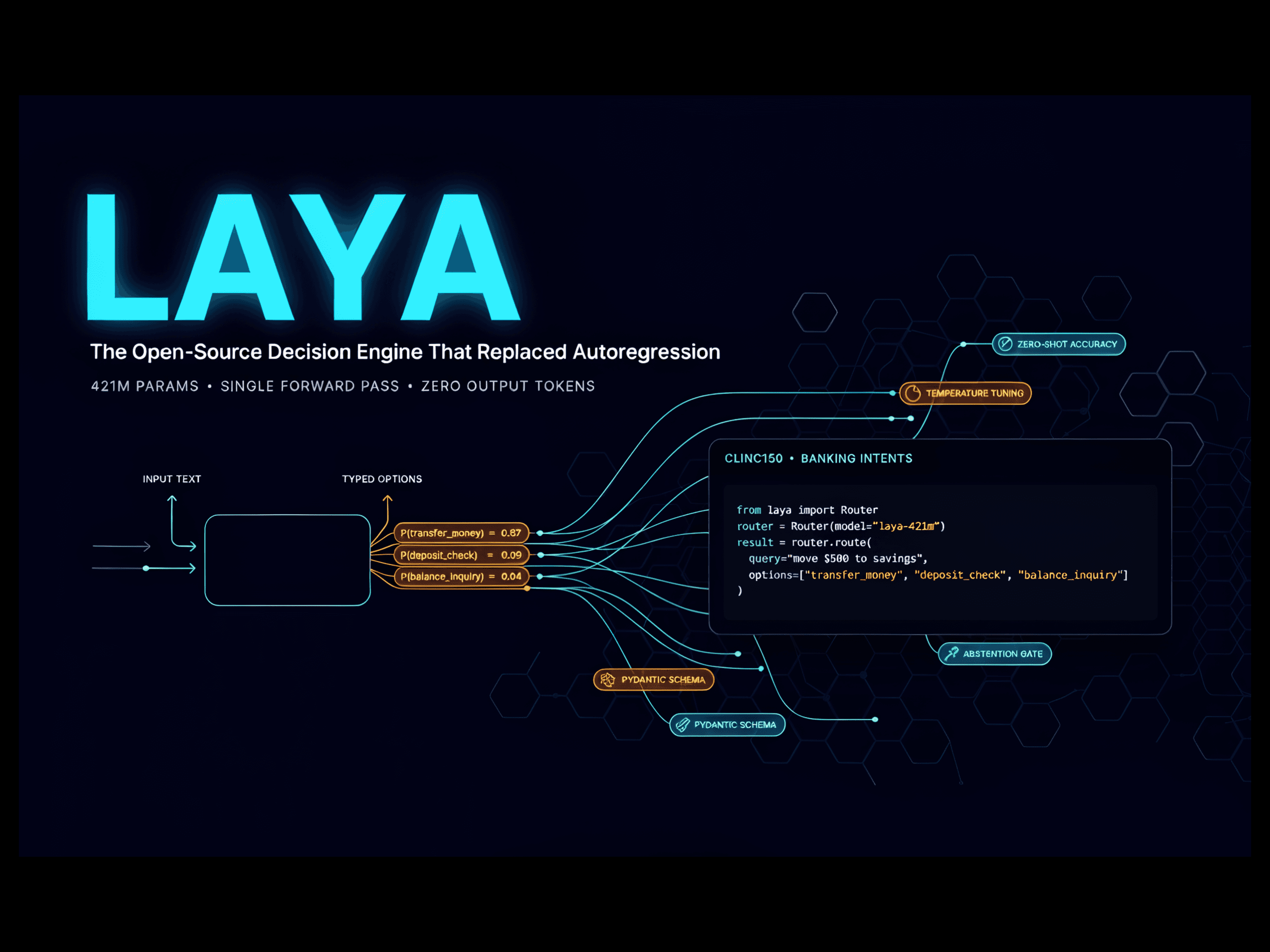
บทช่วยสอนนี้จะพาไปรู้จักกับ Laya เอ็นจินการตัดสินใจแบบโอเพนซอร์สจาก Convai Innovations ซึ่งเป็นคลังเก็บข้อมูล Machine Learning ที่ได้รับความนิยมสูงสุดในเดือนกันยายน 2026
Laya ทำงานเป็นโมเดล System 1 แบบ non-autoregressive ที่ใช้ตัวเข้ารหัส (encoder) ขนาด 421 ล้านพารามิเตอร์ เพื่อวิเคราะห์ข้อความและคำถามที่กำหนดประเภทไว้ล่วงหน้า ไม่ว่าจะเป็นการเลือกเลเบล การให้คะแนน หรือคำถามแบบใช่/ไม่ใช่ โดยจะส่งคืนค่าความน่าจะเป็นจากการประมวลผลเพียงครั้งเดียวโดยไม่มี output tokens แม้แต่ตัวเดียว จุดเด่นอยู่ที่ความเร็วและการสอบเทียบความน่าจะเป็น (calibrated probabilities) ซึ่งเป็นทางเลือกแบบโอเพนซอร์สสำหรับ Jev ของ TypeSafe
เราจะนำ Laya มาทดสอบกับข้อมูลจริงจากชุดข้อมูลเจตนาด้านการธนาคาร CLINC150 เพื่อวัดผลประสิทธิภาพในหลายมิติ เช่น ความแม่นยำแบบ zero-shot เมื่อเทียบกับลักษณนาม (classifier) ทั่วไป, ผลกระทบจากการเลือกใช้คำและลำดับตัวเลือก, ความซื่อสัตย์ของค่าความน่าจะเป็น, การปรับจูนอุณหภูมิบนข้อมูล validation, การสร้างเกตการสละสิทธิ์ (abstention gates) เพื่อควบคุมข้อผิดพลาด และการจัดการทราฟฟิกนอกขอบเขต (out-of-scope) ผ่าน pydantic schema
import os
import sys
import time
import json
import warnings
import traceback
import subprocess
import urllib.request

RESULTS = {}

def banner(title):
    print("\n" + "=" * 78)
    print(title)
    print("=" * 78)

def section(name):
    def wrap(fn):
        def run(*a, **kw):
            banner(name)
            try:
                out = fn(*a, **kw)
                RESULTS[name] = out if isinstance(out, str) else "ok"
                return out
            except Exception as e:
                RESULTS[name] = f"SKIPPED / FAILED -> {type(e).__name__}: {e}"
                print(f"\n[!] {name} did not complete: {type(e).__name__}: {e}")
                traceback.print_exc(limit=3)
                return None
        return run
    return wrap

banner("1. Install Laya and load the English checkpoint at its reviewed revision")
subprocess.run([sys.executable, "-m", "pip", "install", "-q", "laya==0.3.27"], check=True)

import numpy as np
import pandas as pd
import torch
import laya
from laya.calibrate import records_from_labeled
from laya.evals import selective_accuracy, aurc
from laya.common import temp_bucket

DEVICE = "cuda" if torch.cuda.is_available() else "cpu"
# laya.load() follows the Hub's main branch unless told otherwise. The package ships the commit
# its authors reviewed for each checkpoint; pinning it keeps this notebook's weights fixed.
REVISION = laya.PINNED_REVISIONS["convaiinnovations/laya"]
with warnings.catch_warnings(record=True) as caught:
    warnings.simplefilter("always")
    agent = laya.load("convaiinnovations/laya", device=DEVICE, revision=REVISION)
# On CUDA Laya autocasts to fp16/bf16. Turning that off keeps every device in fp32, so a GPU run
# reproduces the CPU numbers printed below to within floating-point noise.
agent.amp_enabled = False
SHIPPED = (list(agent.temperature), dict(agent.temperature_by_options))

n_params = sum(p.numel() for p in agent.model.parameters())
print(f"  laya {laya.__version__}  |  torch {torch.__version__}  |  device {DEVICE}, fp32")
print(f"  checkpoint convaiinnovations/laya @ {REVISION[:7]}  |  {n_params / 1e6:.0f}M parameters"
      f"  |  max_len {agent.cfg['max_len']}, head_max_len {agent.cfg['head_max_len']}")
print("\n  Temperatures shipped with the checkpoint (probabilities = softmax(logits / T)):")
for qt, name in enumerate(["choice", "score", "noul"]):
    print(f"    {name:7s} type-level T = {SHIPPED[0][qt]:.3f}")
for bucket, t in sorted(SHIPPED[1].items()):
    print(f"    {bucket:12s} T = {t:.3f}")
for w in caught:
    if "temperature" in str(w.message):
        print("\n  Warning at load time:\n    " + str(w.message).replace("; ", ";\n    "))
print("\n  T > 1 softens probabilities and T < 1 sharpens them. Remember the choice:11+ row: the")
print("  checkpoint ships 0.10 there, which the loader clamps to 0.5, so any choice question with")
print("  11 or more options gets probabilities SHARPENED by 2x. Step 6 measures what that costs.")
เราเริ่มต้นด้วยการติดตั้งแพ็กเกจ Laya 0.3.27 และโหลด English checkpoint โดยการระบุ Revision ที่แน่นอนผ่าน laya.PINNED_REVISIONS เพื่อให้ผลลัพธ์คงที่ และปิดการ autocast บน CUDA เพื่อให้การรันในโหมด fp32 ให้ผลลัพธ์ที่ตรงกันทั้งบน GPU และ CPU
จากการตรวจสอบค่าอุณหภูมิที่มาพร้อมกับ checkpoint พบข้อมูลที่น่าสนใจคือ คำถามที่มีตัวเลือกตั้งแต่ 11 ตัวขึ้นไปมีการกำหนดค่าไว้ที่ 0.10 ซึ่งอยู่นอกช่วงใช้งานปกติ ระบบจึงปรับมาอยู่ที่ 0.5 พร้อมแจ้งเตือน โดยอุณหภูมิที่ต่ำกว่า 1 จะทำให้ความน่าจะเป็นดูชัดเจนขึ้น (sharpen) ส่งผลให้คำตอบดูมีความแน่นอนสูงกว่าความเป็นจริงถึงสองเท่า
TICKET = "Hi, we were billed twice for March. Please refund the duplicate today or we will cancel our plan."
TRIAGE = {
    "department": {"type": "choice", "instructions": "Which department should handle this?",
                   "criteria": {"billing": "invoices, payments, refunds",
                                "technical": "bugs, outages, system errors",
                                "other": "everything else"}},
    "urgency": {"type": "score", "instructions": "How urgent is this?",
                "criteria": ["not urgent", "soon", "blocking"]},
    "churn_risk": {"type": "noul", "instructions": "Does the user threaten to cancel or leave?"},
}

@section("2. One forward pass, three typed questions, zero output tokens")
def first_decision():
    r = agent.predict(TICKET, TRIAGE)
    a = r["answers"]
    d, u, c = a["department"], a["urgency"], a["churn_risk"]
    print(f"  state: {TICKET!r}\n")
    print(f"  department (choice)  -> {d['choice']!r}   probabilities {d['probabilities']}")
    print(f"  urgency    (score)   -> {u['score']:.2f} on 0..2   level probabilities {u['probabilities']}")
    print(f"  churn_risk (noul)    -> P(yes) = {c['noul']:.3f}")
    print("\n  Two confidence fields, two different quantities:")
    for qid, ans in a.items():
        print(f"    {qid:11s} answer_confidence {ans['answer_confidence']:.3f}   confidence {ans['confidence']:.3f}")
    print("  answer_confidence is the probability of the reported answer, max(p): the number that")
    print("  calibration, the abstention gate and every metric below use. confidence is 1 - normalised")
    print("  entropy, whose scale depends on the number of options. Do not threshold on it.")
    print(f"\n  usage: {r['usage']}")
    print("  output_tokens is always 0: Laya scores the options it is given and never generates text.")
    return f"{d['choice']} / urgency {u['score']:.2f} / P(churn) {c['noul']:.2f} in one pass"

first_decision()
ฟังก์ชัน predict ของ Laya สามารถตอบคำถามที่กำหนดประเภทไว้ 3 ข้อพร้อมกันในการประมวลผลเดียว ได้แก่ แผนก (choice), ความเร่งด่วน (score) และความเสี่ยงการเลิกใช้งาน (yes/no)
ผลลัพธ์จะให้ค่าความเชื่อมั่นสองแบบคือ answer_confidence (ความน่าจะเป็นของคำตอบนั้นๆ) ซึ่งใช้สำหรับการสอบเทียบและสร้างเกตสละสิทธิ์ ส่วน confidence คือค่าที่คำนวณจาก entropy ซึ่งแปรผันตามจำนวนตัวเลือกและไม่ควรนำไปใช้เป็นเกณฑ์ตัดสินใจหลัก ทั้งนี้บล็อก usage ยืนยันว่าไม่มีการสร้าง output tokens เลย เพราะโมเดลเพียงแค่ให้คะแนนตัวเลือกที่มีอยู่เท่านั้น
@section("3. What a pass costs: questions are rows, options are nearly free")
def cost_model():
    def median_ms(q, n=7):
        agent.predict(TICKET, q)
        times = []
        for _ in range(n):
            t0 = time.perf_counter()
            r = agent.predict(TICKET, q)
            times.append(1000 * (time.perf_counter() - t0))
        return float(np.median(times)), r["usage"]["input_tokens"]

print(f"  {'one state, asking ...':34s} {'ms (median of 7)':>16s} {'input_tokens':>13s}")
    rows = {}
    for n in (1, 4, 16):
        q = {f"q{i}": {"type": "noul", "instructions": f"Does the message mention topic number {i}?"} for i in range(n)}
        rows[f"{n} yes/no"] = median_ms(q)
        print(f"  {f'{n:2d} yes/no questions':34s} {rows[f'{n} yes/no'][0]:16.1f} {rows[f'{n} yes/no'][1]:13d}")
    for k in (3, 15, 40):
        q = {"pick": {"type": "choice", "instructions": "Pick one", "criteria": [f"option {i}" for i in range(k)]}}
        rows[f"{k} options"] = median_ms(q)
        print(f"  {f'1 choice question, {k:2d} options':34s} {rows[f'{k} options'][0]:16.1f} {rows[f'{k} options'][1]:13d}")
    print("\n  Every question is encoded as its own (state, question) row, so 16 yes/no questions cost")
    print("  roughly 16 rows. All options of one choice question share a single row and its head")
    print("  budget, so 40 options cost far less than 40 yes/no questions. Design rule: ask one")
    print("  choice question with many options, not many yes/no questions.")
    return (f"16 yes/no {rows['16 yes/no'][0]:.0f} ms vs one 40-option choice "
            f"{rows['40 options'][0]:.0f} ms")

cost_model()
ด้านประสิทธิภาพการประมวลผล พบว่าคำถามแต่ละข้อจะถูกมองเป็นหนึ่งแถวข้อมูล ดังนั้นคำถามใช่/ไม่ใช่ 16 ข้อจะใช้เวลานานกว่าคำถามเดียวถึง 8 เท่า แต่สำหรับคำถามแบบ choice ตัวเลือกทั้งหมดจะใช้แถวประมวลผลร่วมกัน
จากการทดสอบบน CPU การมีตัวเลือกถึง 40 ทางเลือกในคำถามเดียวใช้ทรัพยากรมากกว่าการมี 3 ตัวเลือกเพียงเล็กน้อย และประหยัดกว่าการตั้งคำถามใช่/ไม่ใช่ 16 ข้อถึง 4 เท่า กฎการออกแบบที่สำคัญคือควรตั้งคำถามแบบ choice หนึ่งข้อที่มีหลายตัวเลือก แทนการใช้คำถามใช่/ไม่ใช่หลายข้อแยกกัน
CARD = json.load(urllib.request.urlopen("https://huggingface.co/api/datasets/clinc/clinc_oos"))["cardData"]
PLUS = next(c for c in CARD["dataset_info"] if c["config_name"] == "plus")
NAMES = {int(k): v for k, v in PLUS["features"][1]["dtype"]["class_label"]["names"].items()}

def clinc(split):
    df = pd.read_parquet(f"https://huggingface.co/api/datasets/clinc/clinc_oos/parquet/plus/{split}/0.parquet")
    return df.assign(label=df.intent.map(NAMES))

# The banking domain of CLINC150 (15 intents), with the one-line descriptions a developer would write.
DESCRIBED = {
    "balance": "checking how much money is in an account",
    "transactions": "looking up recent transactions on an account",
    "transfer": "moving money between accounts or to another person",
    "freeze_account": "freezing or locking an account",
    "account_blocked": "an account that is blocked or locked and cannot be used",
    "pay_bill": "paying a bill",
    "bill_balance": "how much is owed on a bill",
    "bill_due": "when a bill is due",
    "interest_rate": "the interest rate on an account",
    "min_payment": "the minimum payment that is due",
    "order_checks": "ordering new checks or a checkbook",
    "pin_change": "changing a PIN",
    "report_fraud": "reporting fraud or suspicious activity",
    "routing": "the bank routing number",
    "spending_history": "how much was spent over a period or on a category",
}
INTENTS = list(DESCRIBED)
ASK = "Which banking request is this?"

def route(states, criteria, **kw):
    """One choice question over `criteria` for every state; returns choices, confidences, results."""
    res = agent.predict_batch(list(states), {"intent": {"type": "choice", "instructions": ASK, "criteria": criteria}},
                              batch_size=32, **kw)
    return (np.array([r["answers"]["intent"]["choice"] for r in res]),
            np.array([r["answers"]["intent"]["answer_confidence"] for r in res]), res)

@section("4. Real labelled data: CLINC150 banking, zero-shot vs. a trained classifier")
def zero_shot_vs_trained():
    global train, val, test, BTRAIN, BVAL, BTEST
    train, val, test = clinc("train"), clinc("validation"), clinc("test")
    BTRAIN, BVAL, BTEST = (d[d.label.isin(INTENTS)].reset_index(drop=True) for d in (train, val, test))
    print(f"  CLINC150 'plus': {len(train):,} / {len(val):,} / {len(test):,} train / validation / test queries,"
          f" 150 intents + out-of-scope")
    print(f"  banking domain: {len(INTENTS)} intents; {len(BTRAIN)} train, {len(BVAL)} validation, {len(BTEST)} test queries")
    print(f"  e.g. {BTEST.text[0]!r} -> {BTEST.label[0]}")

t0 = time.time()
    pred, conf, _ = route(BTEST.text, DESCRIBED)
    secs = time.time() - t0
    acc = float((pred == BTEST.label).mean())
    globals()["DESCRIBED_ACC"], globals()["DESCRIBED_PRED"] = acc, pred
    print(f"\n  Laya, zero-shot, 15 options with descriptions: accuracy {acc:.3f}"
          f"   ({secs:.0f}s for {len(BTEST)} queries on {DEVICE})")

from sklearn.feature_extraction.text import TfidfVectorizer
    from sklearn.linear_model import LogisticRegression
    print("\n  TF-IDF + logistic regression trained on k labelled queries per intent (5 draws for k < 100):")
    curve = {}
    for k in (1, 3, 10, 30, 100):
        accs = []
        for seed in range(5 if k < 100 else 1):
            sub = BTRAIN.groupby("label", group_keys=False).sample(k, random_state=seed)
            vec = TfidfVectorizer(ngram_range=(1, 2), sublinear_tf=True)
            clf = LogisticRegression(max_iter=3000, C=10).fit(vec.fit_transform(sub.text), sub.label)
            accs.append(float((clf.predict(vec.transform(BTEST.text)) == BTEST.label).mean()))
        curve[k] = float(np.mean(accs))
        print(f"    k = {k:3d}  ({k * len(INTENTS):5,d} labels)   accuracy {curve[k]:.3f}  (sd {np.std(accs):.3f})")
    globals()["CURVE"] = curve
    print("\n  Zero-shot Laya, with nothing but the intent descriptions, lands between what a classic")
    print("  classifier reaches with three and with ten labelled examples per intent. Step 5 shows the")
    print("  descriptions are the weak part.")
    return f"zero-shot {acc:.3f}; TF-IDF needs 10/intent for {curve[10]:.3f}"

zero_shot_vs_trained()
ในการทดสอบกับข้อมูลจริง เราใช้ชุดข้อมูลมาตรฐาน CLINC150 ในโดเมนการธนาคารซึ่งมี 15 เจตนา Laya ทำความแม่นยำแบบ zero-shot ได้ถึง 0.804 โดยเพียงแค่ใช้ชื่อเจตนาและคำอธิบายสั้นๆ หนึ่งบรรทัด
เมื่อเทียบกับลักษณนามแบบดั้งเดิมอย่าง TF-IDF ร่วมกับ Logistic Regression พบว่า Laya ให้ผลลัพธ์ที่ดีกว่าโมเดลที่ฝึกด้วยข้อมูลเลเบล 3 ตัวอย่างต่อเจตนา (0.651) และใกล้เคียงกับโมเดลที่ฝึกด้วยข้อมูล 10 ตัวอย่างต่อเจตนา (0.848) โดยที่ Laya ไม่ต้องใช้ข้อมูลฝึกสอนเลย
@section("5. Criteria wording and option order change the answers")
def wording_and_order():
    t0 = time.time()
    pred_n, conf_n, res_n = route(BTEST.text, INTENTS)
    secs = time.time() - t0
    acc_n = float((pred_n == BTEST.label).mean())
    pred_r, _, _ = route(BTEST.text, INTENTS[::-1])
    acc_r = float((pred_r == BTEST.label).mean())
    flips = float((pred_r != pred_n).mean())
    print(f"  {'criteria':44s} {'accuracy':>8s}")
    print(f"  {'15 names with one-line descriptions (step 4)':44s} {DESCRIBED_ACC:8.3f}")
    tok = {name: agent.predict(BTEST.text[0], {"intent": {"type": "choice", "instructions": ASK, "criteria": c}})
           ["usage"]["input_tokens"] for name, c in (("described", DESCRIBED), ("names", INTENTS))}
    print(f"  {'15 bare intent names':44s} {acc_n:8.3f}   ({secs:.0f}s; {tok['names']} input tokens per query"
          f" vs {tok['described']})")
    print(f"  {'15 bare intent names, order reversed':44s} {acc_r:8.3f}")
    print(f"\n  Reversing the option order changes {flips:.1%} of individual answers, even where the")
    print("  overall accuracy barely moves: the model has a position prior, so fix the order you deploy.")
    changed = pd.DataFrame({"label": BTEST.label, "described": DESCRIBED_PRED, "names": pred_n})
    gained = changed[(changed.names == changed.label) & (changed.described != changed.label)]
    lost = changed[(changed.names != changed.label) & (changed.described == changed.label)]
    print(f"\n  Bare names fixed {len(gained)} answers the descriptions got wrong and broke {len(lost)};"
          f" the most common fixes:")
    for (lab, was), n in gained.groupby(["label", "described"]).size().sort_values(ascending=False).head(3).items():
        print(f"    {lab:16s} had been routed to {was:16s} x{n}")
    print("\n  More text is not more signal. The descriptions we wrote blurred intents the names keep")
    print("  apart, and only labelled data could tell us. From here on we route on the bare names.")
    globals().update(PRED=pred_n, CONF=conf_n)
    return f"descriptions {DESCRIBED_ACC:.3f} -> names {acc_n:.3f}; reversed order flips {flips:.1%}"

wording_and_order()
การทดลองถัดมาพบว่า "น้อยแต่มาก" เป็นเรื่องจริง การใช้เพียงชื่อเจตนาเปล่าๆ โดยไม่มีคำอธิบาย ช่วยเพิ่มความแม่นยำจาก 0.804 เป็น 0.878 และประหยัดเวลาประมวลผลไปครึ่งหนึ่ง เพราะคำอธิบายที่เยิ่นเย้อกลับทำให้ความหมายของเจตนาบางอย่างพร่ามัว เช่น account_blocked มักถูกสับสนกับ freeze_account
นอกจากนี้ การสลับลำดับตัวเลือกส่งผลให้คำตอบเปลี่ยนไปถึง 4.2% แม้ความแม่นยำรวมจะเท่าเดิม ซึ่งสะท้อนถึงอคติด้านตำแหน่ง (position prior) ดังนั้นการเลือกใช้คำและลำดับตัวเลือกที่ทดสอบแล้วว่าดีที่สุดในการใช้งานจริงจึงเป็นเรื่องสำคัญ
def reliability(conf, correct, title):
    bins = np.linspace(0, 1, 11)
    idx = np.clip(np.digitize(conf, bins) - 1, 0, 9)
    print(f"  {title}\n    {'confidence':>12s} {'answers':>8s} {'mean conf':>10s} {'accuracy':>9s}")
    for i in range(10):
        m = idx == i
        if m.sum():
            print(f"    {bins[i]:5.1f}-{bins[i + 1]:.1f}   {m.sum():8d} {conf[m].mean():10.3f} {correct[m].mean():9.3f}")

@section("6. How honest are the probabilities as shipped?")
def shipped_calibration():
    ok = PRED == BTEST.label.values
    ece = laya.ece_score(CONF, ok)
    bucket = temp_bucket(laya.QTYPES["choice"], len(INTENTS))
    print(f"  15-option question -> temperature bucket {bucket!r}, T = {agent.temperature_by_options.get(bucket):.2f}\n")
    reliability(CONF, ok, "Reliability on the 450 test queries:")
    print(f"\n  accuracy {ok.mean():.3f}, mean answer_confidence {CONF.mean():.3f}, ECE {ece:.3f} (15 bins)")
    top = CONF >= 0.9
    print(f"  {top.mean():.0%} of answers claim >= 0.9 confidence; {ok[top].mean():.1%} of those are right.")
    print("\n  The model is over-confident here, and the clamp is part of why: with T = 0.5 every")
    print("  15-option answer is sharpened before you see it. 'Calibrated' in a model card describes a")
    print("  training objective, not a property of your question. Measure it on your own labels.")
    globals()["ECE_SHIPPED"] = ece
    return f"ECE {ece:.3f} as shipped; accuracy {ok.mean():.3f} at mean confidence {CONF.mean():.3f}"

shipped_calibration()
ความซื่อสัตย์ของความน่าจะเป็นเป็นประเด็นสำคัญ ในคำถามที่มี 15 ตัวเลือก โมเดลแสดงอาการมั่นใจเกินจริง (over-confident) โดย 92% ของคำตอบระบุความเชื่อมั่นมากกว่า 0.9 แต่มีเพียง 91.1% เท่านั้นที่ตอบถูก
สาเหตุส่วนหนึ่งเกิดจากการ clamp ค่าอุณหภูมิไว้ที่ 0.5 ซึ่งทำให้ผลลัพธ์ดูมีความแน่นอนเกินไป แม้ Laya จะระบุใน Model Card ว่าได้รับการสอบเทียบแล้ว แต่ในทางปฏิบัติ การสอบเทียบเป็นคุณสมบัติที่แปรผันตามชุดคำถามและข้อมูล ดังนั้นผู้พัฒนาจึงควรวัดผลด้วยข้อมูลของตนเองเสมอ
@section("7. Fit a temperature on validation data, without breaking the other questions")
def fit_temperature():
    eye = np.eye(len(INTENTS))
    pairs = [(s, {"intent": {"type": "choice", "instructions": ASK, "criteria": INTENTS}},
              {"intent": eye[INTENTS.index(l)]}) for s, l in zip(BVAL.text, BVAL.label)]
    t0 = time.time()
    records = records_from_labeled(agent, pairs)
    print(f"  {len(records)} labelled validation records (raw logits + one-hot targets) in {time.time() - t0:.0f}s")

fit = agent.fit_temperatures(records)
    after = (list(agent.temperature), dict(agent.temperature_by_options))
    print(f"  fitted on bucket counts {fit['n_by_bucket']}; choice temperature {fit['temperature'][0]:.3f}")
    print("\n  What agent.fit_temperatures() just installed, next to what shipped:")
    print(f"    {'':14s} {'shipped':>8s} {'after':>8s}")
    for qt, name in enumerate(["choice", "score", "noul"]):
        print(f"    {name + ' (type)':14s} {SHIPPED[0][qt]:8.3f} {after[0][qt]:8.3f}")
    for bucket in sorted(SHIPPED[1]):
        now = after[1].get(bucket)
        print(f"    {bucket:14s} {SHIPPED[1][bucket]:8.3f} {('%.3f' % now) if now is not None else '  (gone)':>8s}")
    print("\n  One fit on choice questions replaced the whole map: every per-bucket entry is gone (a bucket")
    print("  needs 2,000 records to keep its own temperature) and the score and noul temperatures were reset")
    print("  to 1.0 because there were no records of those types. Every yes/no question now uses a")
    print("  different temperature than it did a minute ago. Install only what you measured instead:")
    agent.temperature, agent.temperature_by_options = list(SHIPPED[0]), dict(SHIPPED[1])
    agent.temperature_by_options["choice:11+"] = fit["temperature"][0]
    print(f"    agent.temperature_by_options['choice:11+'] = {fit['temperature'][0]:.3f}   (all else as shipped)")

pred, conf, _ = route(BTEST.text, INTENTS)
    ok = pred == BTEST.label.values
    ece = laya.ece_score(conf, ok)
    print()
    reliability(conf, ok, "Reliability on the same 450 test queries, after the fit:")
    print(f"\n  ECE 0.102 -> {ece:.3f}; accuracy unchanged at {ok.mean():.3f} (temperature never changes the argmax)")
    agent.save_calibration("laya_banking_calibration.json")
    saved = json.load(open("laya_banking_calibration.json"))
    print(f"  saved with agent.save_calibration(): keys {sorted(saved)}; reload with laya.load(..., calibration=path)")
    globals().update(RECORDS=records, CONF_FIT=conf, OK_FIT=ok)
    return f"ECE 0.102 -> {ece:.3f} from {len(records)} validation queries"

fit_temperature()
เราใช้โมดูลการสอบเทียบของ Laya เพื่อปรับค่าอุณหภูมิจากชุดข้อมูล validation 300 เรคคอร์ด พบว่าเมื่อใช้ fit_temperatures ระบบจะเปลี่ยนค่าอุณหภูมิแบบ choice เป็น 1.258 แต่มีข้อควรระวังคือฟังก์ชันนี้จะล้างค่าอุณหภูมิของประเภทอื่นที่เราไม่ได้วัดผลทิ้งไปด้วย
ทางแก้คือการอัปเดตเฉพาะ bucket ที่เราทดสอบจริง ซึ่งในกรณีนี้ช่วยลดข้อผิดพลาดการสอบเทียบ (ECE) จาก 0.102 เหลือ 0.059 โดยไม่กระทบความแม่นยำรวม เพราะการปรับอุณหภูมิไม่มีผลต่อการเลือกตัวเลือกที่คะแนนสูงสุด (argmax) และผลลัพธ์นี้สามารถบันทึกเป็นไฟล์ JSON เพื่อโหลดใช้งานภายหลังได้
@section("8. An abstention gate fitted to an error budget")
def abstention_gate():
    t = agent.temperature_by_options["choice:11+"]
    z = np.array([r[1] for r in RECORDS]) / t
    p_val = np.exp(z - z.max(1, keepdims=True)); p_val /= p_val.sum(1, keepdims=True)
    conf_val = p_val.max(1)
    ok_val = np.array([np.argmax(r[1]) == np.argmax(r[2]) for r in RECORDS])
    print(f"  {'target':>6s} {'threshold':>10s}   {'validation: kept / error':>25s}   {'test: kept / error':>19s}")
    gates = {}
    for target in (0.02, 0.05, 0.10):
        thr = laya.fit_abstention_thresholds(RECORDS, agent.temperature, agent.temperature_by_options,
                                             target_error=target)
        cut = thr["choice:11+"]
        kv, kt = conf_val >= cut, CONF_FIT >= cut
        gates[target] = thr
        print(f"  {target:6.0%} {cut:10.3f}   {kv.mean():14.1%} / {1 - ok_val[kv].mean():5.1%}"
              f"   {kt.mean():11.1%} / {1 - OK_FIT[kt].mean():5.1%}")
    _, _, res = route(BTEST.text, INTENTS, min_confidence=gates[0.05])
    states = pd.Series([r["answers"]["intent"]["abstention"] for r in res]).value_counts().to_dict()
    print(f"\n  The 5% gate applied by Laya itself, predict_batch(min_confidence=...): {states}")
    conf, ok = CONF_FIT.tolist(), OK_FIT.tolist()
    print(f"  selective accuracy on test: top 50% by confidence {selective_accuracy(conf, ok, 0.5):.3f},"
          f" top 80% {selective_accuracy(conf, ok, 0.8):.3f}, all {np.mean(ok):.3f};  AURC {aurc(conf, ok):.3f}")
    print(f"\n  On validation every cut meets its target, by construction. On test the realised error is")
    print(f"  higher, because the test queries are harder: accuracy is {ok_val.mean():.3f} on validation and"
          f" {OK_FIT.mean():.3f}")
    print("  on test. A gate fitted to an error budget holds only for traffic that looks like the data it")
    print("  was fitted on. Fit it on a sample of real traffic, re-check it as traffic drifts, and leave")
    print("  margin. Thresholds are per option-count bucket because one number does not transfer between")
    print("  a 2-way and a 15-way question.")
    globals()["GATE"] = gates[0.05]
    kept = CONF_FIT >= gates[0.05]["choice:11+"]
    return f"5% target: {1 - OK_FIT[kept].mean():.1%} error on test at {kept.mean():.1%} coverage"

abstention_gate()
การใช้ fit_abstention_thresholds ช่วยกำหนดเกณฑ์ขั้นต่ำของความเชื่อมั่นเพื่อลดข้อผิดพลาด เช่น หากต้องการคุมความผิดพลาดให้อยู่ที่ 5% ระบบจะตัดที่ความเชื่อมั่น 0.602
อย่างไรก็ตาม ค่าที่ปรับจูนจากข้อมูลชุดหนึ่งอาจไม่ได้ผลสมบูรณ์แบบกับข้อมูลอีกชุดหนึ่ง เช่น ในชุดทดสอบพบข้อผิดพลาดจริงถึง 9.2% สูงกว่าเป้าหมายที่ 5% สรุปได้ว่าการกำหนดงบประมาณความผิดพลาดต้องเผื่อระยะ (margin) และต้องปรับจูนใหม่ตามลักษณะทราฟฟิกจริงที่เปลี่ยนไปเสมอ
@section("9. Out-of-scope traffic: the gate vs. an explicit 'other' option")
def out_of_scope():
    global OOS, OTHER
    OOS = test[test.label == "oos"].sample(150, random_state=0).reset_index(drop=True)
    OTHER = test[~test.label.isin(INTENTS + ["oos"])].sample(150, random_state=0).reset_index(drop=True)
    print(f"  {len(OOS)} out-of-scope queries (e.g. {OOS.text[0]!r})")
    print(f"  {len(OTHER)} in-scope queries from other CLINC domains (e.g. {OTHER.text[0]!r})\n")

groups = {"banking": BTEST.text, "other domains": OTHER.text, "out of scope": OOS.text}
    conf = {g: route(s, INTENTS)[1] for g, s in groups.items()}
    thr = GATE["choice:11+"]
    print(f"  A) 15 intents + the 5% gate (threshold {thr:.3f}): share of each group the gate stops")
    for g in groups:
        print(f"     {g:14s} mean confidence {conf[g].mean():.3f}   abstained {(conf[g] < thr).mean():6.1%}")

with_other = INTENTS + ["not a banking request"]
    print(f"\n  B) 16 options: the 15 intents + 'not a banking request', no gate")
    picks = {g: route(s, with_other)[0] for g, s in groups.items()}
    for g in groups:
        print(f"     {g:14s} routed to 'not a banking request' {(picks[g] == 'not a banking request').mean():6.1%}")
    acc_b = float((picks["banking"] == BTEST.label.values).mean())
    print(f"     banking accuracy with the extra option {acc_b:.3f} (15 intents alone: {OK_FIT.mean():.3f})")
    print("\n  Neither tool is free. The gate needs labelled data and gives up some in-scope coverage;")
    print("  the extra option needs no data but changes the question every intent is scored against.")
    stop = (conf["out of scope"] < thr).mean()
    return f"gate stops {stop:.1%} of out-of-scope queries; 'other' option catches {(picks['out of scope'] == 'not a banking request').mean():.1%}"

out_of_scope()
``` เพื่อจัดการทราฟฟิกนอกขอบเขต เราเปรียบเทียบสองวิธี: วิธีแรกใช้เกตความเชื่อมั่น พบว่าช่วยกรองคำถามนอกโดเมนได้ถึง 93.3% วิธีที่สองคือเพิ่มตัวเลือก "not a banking request" เข้าไปโดยตรง ซึ่งวิธีนี้ไม่ต้องใช้ข้อมูลฝึกสอนและกรองคำถามนอกขอบเขตได้ 90.0% แต่แลกมาด้วยความแม่นยำในเจตนาธนาคารที่ลดลงเล็กน้อย (จาก 0.878 เหลือ 0.864) เนื่องจากตัวเลือกใหม่เปลี่ยนเกณฑ์การให้คะแนนของทุกเจตนา

```python
IN_SCOPE = {"in_scope": {"type": "noul", "instructions": "Is this a request about the user's bank account, bills, or payments?"}}

@section("10. A biased yes/no question, and why temperature cannot fix it")
def biased_noul():
    states = pd.concat([BTEST.text, OTHER.text, OOS.text], ignore_index=True)
    y = np.r_[np.ones(len(BTEST)), np.zeros(len(OTHER) + len(OOS))].astype(bool)
    res = agent.predict_batch(list(states), IN_SCOPE, batch_size=32)
    p = np.array([r["answers"]["in_scope"]["noul"] for r in res])
    from sklearn.metrics import roc_auc_score
    auc = roc_auc_score(y, p)
    print(f"  'Is this a request about the user's bank account, bills or payments?' on 450 banking")
    print(f"  queries and 300 that are not:")
    print(f"    mean P(yes): banking {p[y].mean():.3f}, not banking {p[~y].mean():.3f}   AUROC {auc:.3f}")
    print(f"    at the 0.5 cut: recall {(p[y] >= 0.5).mean():.1%}, specificity {(p[~y] < 0.5).mean():.1%}")

vstates = pd.concat([BVAL.text, val[~val.label.isin(INTENTS + ["oos"])].sample(150, random_state=0).text,
                         val[val.label == "oos"].text], ignore_index=True)
    vy = np.r_[np.ones(len(BVAL)), np.zeros(len(vstates) - len(BVAL))]
    recs = records_from_labeled(agent, [(s, IN_SCOPE, {"in_scope": np.array([1 - t, t])}) for s, t in zip(vstates, vy)])
    t_fit = laya.fit_temperature_map(recs)["temperature"][2]
    print(f"\n  Temperature fitted on {len(recs)} validation answers: T = {t_fit:.2f} (the ceiling is 5.0)")
    print("  Any T leaves the 0.5 cut where it is: dividing two logits by T never changes which is larger.")
    t_ship = agent.temperature_by_options.get("noul:2", agent.temperature[2])
    logits = np.array([r[1] for r in recs])
    p_val = 1 / (1 + np.exp(-(logits[:, 1] - logits[:, 0]) / t_ship))
    cuts = np.linspace(0.01, 0.99, 99)
    bal = [((p_val[vy == 1] >= c).mean() + (p_val[vy == 0] < c).mean()) / 2 for c in cuts]
    cut = float(cuts[int(np.argmax(bal))])
    print(f"\n  What does work is moving the cut. Chosen on validation (best balanced accuracy): {cut:.2f}")
    print(f"    on test at {cut:.2f}: recall {(p[y] >= cut).mean():.1%}, specificity {(p[~y] < cut).mean():.1%}")
    print("\n  The question ranks well and is biased towards 'no'. Temperature scaling repairs a scale,")
    print("  not an offset. Treat P(yes) as a score, and pick its cut on labeled data like any other.")
    globals()["IN_SCOPE_CUT"] = cut
    return f"recall at 0.5 {(p[y] >= 0.5).mean():.1%} -> {(p[y] >= cut).mean():.1%} at a validated cut of {cut:.2f}"

biased_noul()
คำถามใช่/ไม่ใช่ (yes/no) มักมีอคติ เช่น การเช็คขอบเขตข้อมูลธนาคารมีค่าเฉลี่ยความน่าจะเป็นเพียง 0.361 ทำให้ที่จุดตัด 0.5 มีความแม่นยำในการจดจำ (recall) เพียง 28.9%
การปรับอุณหภูมิไม่ช่วยแก้ปัญหานี้เพราะมันปรับที่มาตราส่วน (scale) ไม่ใช่ค่าชดเชย (offset) สิ่งที่ได้ผลคือการมองความน่าจะเป็นเป็นคะแนนแล้วหาจุดตัดใหม่บนข้อมูลเลเบล ซึ่งการปรับจุดตัดมาอยู่ที่ 0.09 ช่วยเพิ่ม recall ขึ้นเป็น 92.0% ในขณะที่ยังรักษาความเฉพาะเจาะจง (specificity) ได้ดี
from typing import Literal, Optional
from pydantic import BaseModel, Field

class BankingRequest(BaseModel):
    intent: Optional[Literal[tuple(INTENTS)]] = Field(description=ASK)
    in_scope: bool = Field(description=IN_SCOPE["in_scope"]["instructions"])

@section("11. Typed decisions from a pydantic schema")
def schema_decisions():
    planned = laya.structured.questions_from_pydantic(BankingRequest)
    crit = planned["intent"]["criteria"]
    print(f"  questions_from_pydantic(BankingRequest): 'intent' -> {planned['intent']['type']} with "
          f"{len(crit)} options, criteria values {set(crit.values())};  'in_scope' -> {planned['in_scope']['type']}")
    print("  A Literal becomes a choice over bare names (what step 5 found works best here); a bool becomes")
    print("  a yes/no question that the projection cuts at 0.5.\n")
    demo = pd.concat([BTEST.iloc[[0, 120, 300]], OOS.iloc[[0, 1]]], ignore_index=True)
    out = laya.decide_batch(agent, list(demo.text), schema=BankingRequest, return_details=True,
                            min_confidence=GATE, batch_size=8)
    for (text, label), d in zip(zip(demo.text, demo.label), out):
        typed = BankingRequest(**d.values)
        p_yes = d.probabilities["in_scope"]["true"]
        print(f"  {text[:46]!r:50s} truth {label}")
        print(f"      -> {typed!r}   P(in_scope) {p_yes:.2f}, at our cut {p_yes >= IN_SCOPE_CUT}")
    print("\n  min_confidence=GATE turns a gated answer into None, so 'intent=None' means 'ask a human',")
    print("  and the pydantic model still validates. in_scope is decided at a fixed 0.5 inside decide();")
    print("  read d.probabilities['in_scope']['true'] and apply the cut from step 10 instead.")
    nones = sum(BankingRequest(**d.values).intent is None for d in out)
    return f"[{len(out)} typed objects, {nones} intents gated to None]"

schema_decisions()
ในขั้นตอนสุดท้าย เรานำระบบไปเชื่อมต่อกับ pydantic schema ผ่าน laya.decide_batch เพื่อจัดการข้อมูลในรูปแบบ Typed Objects โดยเจตนาที่ไม่มั่นใจจะถูกส่งกลับมาเป็น None เพื่อส่งต่อให้มนุษย์ตรวจสอบ
อย่างไรก็ตาม ฟังก์ชัน decide จะตัดค่าบูลีนที่จุดคงที่ 0.5 เสมอ ดังนั้นหากต้องการความแม่นยำสูงสุด ควรดึงค่าความน่าจะเป็นออกมาและใช้จุดตัดที่ผ่านการสอบเทียบแล้วของเราเอง
banner("SUMMARY")
for name, res in RESULTS.items():
    print(f"  {name:<76s}  {res}")
print("""
What to carry over
 - Pin the checkpoint (laya.PINNED_REVISIONS) and know its shipped temperatures before trusting a
   probability: 15-option questions were sharpened by a clamped 0.5.
 - Measure criteria wording and option order on labeled data. Bare names beat our descriptions.
 - Fit temperatures on held-out data, and install only the bucket you measured: fit_temperatures()
   replaces the whole map, including question types you did not fit.
 - Gate per option-count bucket with fit_abstention_thresholds, and leave margin below the target.
 - A yes/no question can rank well and still be biased; choose its cut on labeled data.
Where to go next
 - Fine-tuning: laya.train on the repository's main branch (not yet in the 0.3.27 wheel) and the
   repo's Kaggle / Apple-silicon notebooks train with RLCD and refit temperatures.
 - Other languages: laya.Router() detects the script and routes to laya-multilingual, which ships with
   no fitted temperatures at all.
 - Serving: pip install "laya[serve]" for an HTTP server; laya[mcp] for an MCP tool server.
 - Docs: nandhakishorm.github.io/laya    Code: github.com/NandhaKishorM/laya
""")
สรุปได้ว่า Laya เป็นเครื่องมือที่มีประสิทธิภาพสูง สามารถตอบคำถามได้รวดเร็วและแม่นยำโดยไม่ต้องใช้ข้อมูลฝึกฝนจำนวนมาก อย่างไรก็ตาม ความน่าเชื่อถือของโมเดลขึ้นอยู่กับการสอบเทียบข้อมูลด้วยตัวเอง การปรับจูนอุณหภูมิเฉพาะจุด และการตั้งคำถามที่กระชับ
บทเรียนสำคัญคือคุณไม่สามารถเชื่อค่าเริ่มต้นของโมเดลได้ทั้งหมด โมเดลการตัดสินใจที่สอบเทียบแล้วที่ดีที่สุด คือโมเดลที่คุณนำมาสอบเทียบใหม่ด้วยข้อมูลและคำถามของคุณเองเท่านั้น
ความคิดเห็น (0)
เข้าสู่ระบบเพื่อร่วมแสดงความเห็น
สมัครสมาชิกมาเป็นคนแรกที่แสดงความเห็นกันเลยโบร